In today’s world, Familiar Linux has become a topic of great importance and interest to a wide variety of people. Whether it’s a cultural phenomenon, a historical figure, or a contemporary concept, Familiar Linux has captured the attention of experts, enthusiasts, and scholars alike. Its impact extends to different aspects of modern life, from politics and economics to popular culture and society in general. In this article, we will explore in depth the meaning and relevance of Familiar Linux, analyzing its origins, its evolution over time and its influence on the world today.
Linux distribution for iPAQ machines and other PDAs
Linux distribution
| OS family | Linux (Unix-like) |
|---|---|
| Source model | Open source |
| Latest release | v0.8.4 / / March, 2007 |
| Default user interface |
OPIE, GPE |
| License | GNU GPL |
| Official website | familiar.handhelds.org |
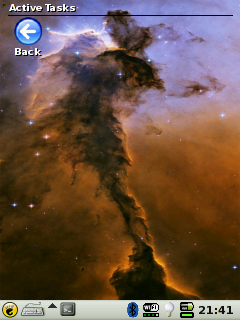
Familiar Linux is a discontinued Linux distribution for iPAQ devices and other personal digital assistants (PDAs),[1][2] intended as a replacement for Windows CE. It can use OPIE or GPE Palmtop Environment as the graphical user interface.
Technical details
It is loosely based on the Debian ARM distribution, but uses the ipkg package manager.[3] It contained Python and XFree86.[4]
History
In May 2000, Alexander Guy took a kernel that had been worked on by Compaq programmers, built a complete Linux distribution around it, and released the first version of Familiar (v0.1).
The first version was released in May 2000.[5]
It was developed as part of the Handhelds.org project.[3]
Reception
According to a 2004 review by IBM developerWorks, Familiar Linux needed more polish and «could gain mass acceptance if a dual-boot procedure were made possible».[6]
References
- ^ Software configuration management : ICSE Workshops SCM 2001 and SCM 2003, Toronto, Canada, May 14-15, 2001 and Portland, OR, USA, May 9-10, 2003 : selected papers. Bernhard Westfechtel, André van der Hoek, SCM. Berlin: Springer. 2003. ISBN 978-3-540-39195-1. OCLC 51975801.
{{cite book}}: CS1 maint: others (link) - ^ Crossing design boundaries : proceedings of the 3rd Engineering & Product Design Education International Conference, Edinburgh, UK, 15-16 September, 2005. Paul Rodgers, E. K. Brodhurst, Duncan Hepburn, Design Society. Design Education Special Interest Group, Institution of Engineering Designers. London: Taylor & Francis. 2005. ISBN 0-415-39118-0. OCLC 63766883.
{{cite book}}: CS1 maint: others (link) - ^ a b «LWN.net weekly edition». LWN.net. Retrieved 2021-04-25.
- ^ «LinuxDevCenter.com: Linux on an iPAQ». O’Reilly Media. 2005-02-27. Archived from the original on 2005-02-27. Retrieved 2021-04-25.
- ^ «In Pictures: Linux for mobile. A visual history». ARNnet. Retrieved 2021-04-26.
- ^ «Running Linux on an iPAQ». IBM developerWorks. 2004-12-15. Archived from the original on 2004-12-15. Retrieved 2021-04-25.
External links
- Official website
- Linux.com interview with the original author Archived 2021-04-25 at the Wayback Machine
| Android |
|
||||||||||||||||
|---|---|---|---|---|---|---|---|---|---|---|---|---|---|---|---|---|---|
| Arch | |||||||||||||||||
| Debian |
|
||||||||||||||||
| Fedora |
|
||||||||||||||||
| Gentoo | |||||||||||||||||
| Mandrake | |||||||||||||||||
| Mandriva | |||||||||||||||||
| Slackware | |||||||||||||||||
| SUSE | |||||||||||||||||
| Other | |||||||||||||||||
| Discontinued |
|
||||||||||||||||


 |
This operating-system-related article is a stub. You can help Wikipedia by expanding it. |
 |
This computing article is a stub. You can help Wikipedia by expanding it. |
 |
This free and open-source software article is a stub. You can help Wikipedia by expanding it. |