In this article we will address Kinner R-5, a topic that has captured the attention and interest of people from various areas and profiles. Kinner R-5 is a widely debated topic that has given rise to conflicting opinions, generating a wide spectrum of analysis, discussions and reflections. Since its inception, Kinner R-5 has been the object of study, research and speculation, arousing curiosity and concern in those who seek to understand, deepen and understand its implications and consequences. Over the years, Kinner R-5 has evolved and has positioned itself as a relevant topic in various contexts, covering social, political, economic, scientific and cultural aspects. In this article, we will explore different perspectives, approaches and debates related to Kinner R-5, with the aim of offering a comprehensive and enriching vision of this exciting topic.
| R-5 | |
|---|---|
,_Kinner_Airplane_%26_Motor_Corporation_-_Oregon_Air_and_Space_Museum_-_Eugene,_Oregon_-_DSC09708.jpg)
|
|
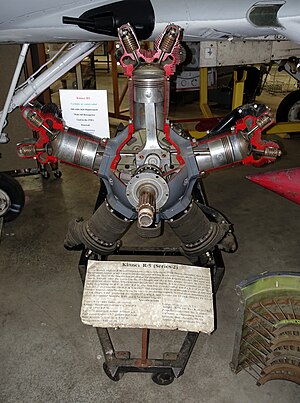
| Kinner R-5 (Series-2) engine, in the Oregon Air and Space Museum | |
| Type | Radial engine |
| Manufacturer | Kinner Airplane & Motor Corporation |
| Developed from | Kinner B-5 |
| Developed into | Kinner C-5 |

The Kinner R-5 is an American five cylinder radial engine for light general and sport aircraft of the 1930s.
Design and development
The R-5 was a development of the earlier Kinner B-5, with slightly greater power and dimensions. The main change was the increase in cylinder bore from 117 mm (4.625 in) to 127 mm (5 in) and an increase in piston stroke from 133.3 mm (5.25 in) to 139.7 mm (5.5 in). This led to a corresponding increase in displacement from 7.2 liters (441 cu in) to 8.8 liters (540 cu in). The R-5 was a rough running but reliable engine. Thousands of the R-5 and its derivatives were produced, powering many World War II trainer aircraft. Its military designation was R-540.
Applications
- Fleet Finch Model R
- Howard DGA-18
- Kinner Sportwing
- Kinner Playboy
- Meyers OTW
- N2T Tutor
- Ryan PT-22 Recruit
Variants
- R-5
- R-53
- R-55
- R-56
Specifications (Kinner R-5)
Data from Jane’s all the World’s Aircraft 1938[1]
General characteristics
- Type: 5-cylinder air cooled radial
- Bore: 5 in (130 mm)
- Stroke: 5.5 in (140 mm)
- Displacement: 540 cu in (8.8 L)
- Length: 32.3 in (820 mm)
- Height: 45.6 in (1,160 mm)
- Dry weight: 330 lb (150 kg)
Components
- Valvetrain: 1 inlet and 1 exhaust valve per cylinder
- Fuel system: 1 Stromberg carburetor
- Fuel type: 73 octane
- Oil system: Dry sump
- Cooling system: Air
Performance
- Power output: 160hp at 1,850 RPM max/113hp at 1,800 RPM cruise
- Compression ratio: 5.5:1
- Power-to-weight ratio: 0.48 hp/lb
See also
Related development
Comparable engines
Related lists
References

- ^ Grey, C.G.; Bridgman, Leonard, eds. (1938). Jane’s all the World’s Aircraft 1938. London: Sampson Low, Marston & company, ltd. p. 88d.
Further reading
- Gunston, Bill (1986). World Encyclopedia of Aero Engines. Wellingborough: Patrick Stephens. pp. 99–100.
External links
- http://www.oldengine.org/members/diesel/Duxford/usaero4.htm Archived 2019-06-03 at the Wayback Machine