When talking about Hevea brasiliensis, it is impossible not to be curious to learn more about this topic. Whether due to its historical relevance, its impact on today’s society or its influence on different aspects of daily life, Hevea brasiliensis has captured the attention of people of all ages and lifestyles. From its origins to its relevance today, Hevea brasiliensis has been an object of study and interest for researchers, academics and curious people alike. In this article we will explore different aspects related to Hevea brasiliensis, as well as its importance and relevance in the current context.
Most common rubber tree
«Rubber tree» and «para rubber» redirect here. For the ornamental plant also known as «rubber tree», see Ficus elastica. For the New Zealand brand Para Rubber, see Skellerup.
| Hevea brasiliensis | |
|---|---|
| Conservation status | |
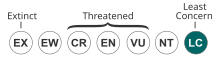 Least Concern (IUCN 3.1)[1] |
|
Scientific classification 
|
|
| Kingdom: | Plantae |
| Clade: | Tracheophytes |
| Clade: | Angiosperms |
| Clade: | Eudicots |
| Clade: | Rosids |
| Order: | Malpighiales |
| Family: | Euphorbiaceae |
| Genus: | Hevea |
| Species: | H. brasiliensis |
| Binomial name | |
| Hevea brasiliensis Müll.Arg. |
|
| Range of the genus Hevea. | |
Hevea brasiliensis, the Pará rubber tree, sharinga tree, seringueira, or most commonly, rubber tree or rubber plant, is a flowering plant belonging to the spurge family, Euphorbiaceae, originally native to the Amazon basin, but is now pantropical in distribution due to introductions. It is the most economically important member of the genus Hevea because the milky latex extracted from the tree is the primary source of natural rubber.
Description

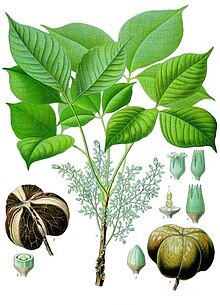
Hevea brasiliensis is a tall deciduous tree growing to a height of up to 43 m (141 ft) in the wild. Cultivated trees are usually much smaller because drawing off the latex restricts their growth. The trunk is cylindrical and may have a swollen, bottle-shaped base. The bark is some shade of brown, and the inner bark oozes latex when damaged. The leaves have three leaflets and are spirally arranged. The inflorescences include separate male and female flowers. The flowers are pungent, creamy-yellow and have no petals. The fruit is a capsule that contains three large seeds; it opens explosively when ripe.[2]
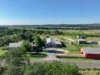
Rubber tree plantation


In the wild the tree can reach a height of up to 43 metres (141 ft). The white or yellow latex occurs in latex vessels in the bark, mostly outside the phloem. These vessels spiral up the tree in a right-handed helix which forms an angle of about 30 degrees with the horizontal, and can grow as high as 15 metres (49 ft).[3]
In plantations the trees are generally smaller for two reasons: 1) trees grow more slowly when they are tapped for latex, and 2) trees are generally cut down after only 30 years, because latex production declines as trees age, and they are no longer economically productive. The tree requires a tropical or subtropical climate with a minimum of about 1,200 mm (50 in) per year of rainfall, and no frost.[4] If frost does occur, the results can be disastrous for production. One frost can cause the rubber from an entire plantation to become brittle and break once it has been refined.[5]
Latex tapping