In today’s world, The Legend of Faust is a topic that has caught the attention of millions of people around the world. From its origins to its impact on today’s society, The Legend of Faust has been the subject of study, debate and controversy. Over the years, it has proven its relevance in different areas, from politics to popular culture. In this article, we will explore the different aspects of The Legend of Faust, analyzing its evolution over time and its influence on today’s society. From its first manifestations to its current consequences, The Legend of Faust continues to be a topic of interest for researchers, academics and the general public.
| The Legend of Faust | |
|---|---|
 |
|
| Directed by | Carmine Gallone |
| Written by | |
| Produced by | Gregor Rabinovitch |
| Starring | |
| Cinematography | |
| Edited by | |
|
Production
company |
Cineopera
|
|
Release date
|
|
|
Running time
|
86 minutes |
| Country | Italy |
| Language | Italian |
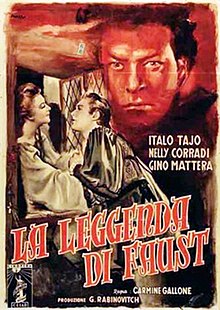
The Legend of Faust (Italian: La leggenda di Faust) is a 1949 Italian drama film directed by Carmine Gallone and starring Italo Tajo, Nelly Corradi and Gino Mattera.[1]
Cast
- Italo Tajo as Mephistofele
- Nelly Corradi as Margherita
- Gino Mattera as Faust
- Onelia Fineschi as Marguerite — Singing (singing voice)
- Livia Venturini
- Cesare Barbetti as Siebel
- Gilles Quéant as Valentino
- Thérèse Dorny as Marta
- Guido Leoncini
- Gualtiero Tumiati
- Claudio Ermelli
References
- ^ Goble p.758
Bibliography
- Goble, Alan. The Complete Index to Literary Sources in Film. Walter de Gruyter, 1999.
External links

 |
This article related to an Italian film of the 1940s is a stub. You can help Wikipedia by expanding it. |