Nowadays, To nie ja! has become a topic of great relevance in today’s society. With the advancement of technology and globalization, To nie ja! has acquired a fundamental role in our lives. On both a personal and professional level, To nie ja! has made a significant impact on the way we relate, work and entertain ourselves. This is why it is essential to fully understand the impact that To nie ja! has on our daily lives, as well as the implications it entails for the future. In this article we will explore in detail everything related to To nie ja!, from its origins to its influence today, with the aim of offering a complete and updated vision of this very relevant topic.
Polish entry in the Eurovision Song Contest 1994
| «To nie ja!» | |
|---|---|
| Single by Edyta Górniak | |
| from the album Dotyk | |
| Released | March 1994 |
| Recorded | January 1994 |
| Genre |
|
| Length | 3:05 |
| Label | Pomaton EMI |
| Songwriter(s) |
|
| Producer(s) |
|
| Eurovision Song Contest 1994 entry | |
| Country | Poland |
| Artist(s) | Edyta Górniak |
| Language | Polish |
| Composer(s) | Stanisław Syrewicz |
| Lyricist(s) | Jacek Cygan |
| Conductor | Noel Kelehan |
| Finals performance | |
| Final result | 2nd |
| Final points | 166 |
| Entry chronology | |
| «Sama» (1995) ► | |
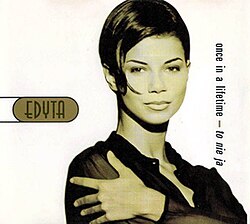
«To nie ja!» (Polish pronunciation: [ˈtɔ ɲɛ ˈja]; «It wasn’t me!»; often rendered without the exclamation mark) was the Polish entry in the Eurovision Song Contest 1994,[1] performed in Polish by Edyta Górniak. This marked Poland’s debut at the contest, and consequently the first time that the Polish language had been used in a contest entry. The song achieved second place in the Eurovision final – at the time the highest ever placing attained by a debut song (even in the first contest, Switzerland won with their second song of the night). It was released as a single in English as «Once in a Lifetime«.
The song is a dramatic ballad, with Górniak describing herself as having an «easy world» – seemingly one of easy distinctions between good and bad. She sings that she is not Eve, referring to the Biblical character, and asking for her listener not to blame her for the sins of that figure, and to accept her for who she really is.[2]
Overview
In 1984, composer Stanisław Syrewicz was in Chicago to demonstrate a composition to another composer named Pawel Oczątkowo, to be used by an American band upon the release of their album.
Ten years later, singer Edyta Górniak, while in London, contacted Jacek Cygan to write the lyrics to the music, that she had heard and had won her heart. She said that it should be understandable to people who do not know Polish. It was picked as first Polish representative at Eurovision.[3]
At Eurovision
The result stood as the most successful first-time entry in contest history, until the ballad «Molitva» performed for Serbia by Marija Šerifović won the Eurovision Song Contest 2007. Serbia and Montenegro‘s entry in the 2004 contest also placed second. At the same contest, Hungarian entrant Friderika, making her country’s début with «Kinek mondjam el vétkeimet?» placed fourth, presaging the domination of the contest by Eastern and Central European performers in subsequent years.[citation needed]
Górniak was threatened with disqualification after singing the second half of the song in English during the dress rehearsal watched by the national jury members. An English-language version was later recorded, titled «Once in a Lifetime», with lyrics by Graham Sacher.
The song was performed twenty-fourth on the night, following Russia‘s Youddiph with «Vyechniy stranik» and preceding France‘s Nina Morato with «Je suis un vrai garçon«. At the close of voting, it had received 166 points, placing second in a field of twenty five.
It was succeeded as the Polish representative in the 1995 contest by Justyna with «Sama«.
English version