In this article we will address the topic of Monsignor, which has aroused great interest in today’s society. Monsignor is a topic that impacts different areas of daily life, from politics and economics, to culture and education. It is a topic that generates debate, reflection and criticism, and that, without a doubt, is fundamental to understanding current reality. Throughout this article we will explore different aspects of Monsignor, analyzing its impact, its implications and its relevance in today’s world. In addition, we will present different perspectives and expert opinions on Monsignor, with the aim of offering a complete and enriching vision of this topic that is so relevant today.
Honorific form of address for certain Catholic clergy
«Mgr.» redirects here. For the 1982 film, see Monsignor (film). For the French equivalent, see Monseigneur.


Monsignor (/mɒnˈsiːnjər/; Italian: monsignore [monsiɲˈɲoːre]) is a form of address or title for certain members of the clergy in the Catholic Church. Monsignor is the apocopic form of the Italian monsignore, meaning «my lord». «Monsignor» can be abbreviated as Mons.[1][2][3][4] or Msgr.[a][b] In some countries, the title «monsignor» is used as a form of address for bishops.[citation needed] However, in English-speaking countries, the title is unrelated to the episcopacy, though many priests with the title later become bishops.[1][2][3][4]
The title «monsignor» is a form of address, not an appointment (such as a bishop or cardinal). A priest cannot be «made a monsignor» or become «the monsignor of a parish». The title «Monsignor» is normally used by clergy who have received one of the three classes of papal honors:
- Protonotary apostolic (the highest honored class)
- Honorary prelate
- Chaplain of His Holiness (the lowest honored class)
The pope bestows these honors upon clergy who:
- Have rendered a valuable service to the church
- Provide some special function in church governance
- Are members of bodies such as certain chapters
Clerics working in the Roman Curia and the Vatican diplomatic service are eligible for all three honors. Priests working in a diocese are only eligible for the «Chaplain of His Holiness» honor. Priests must be nominated by their bishop and (for appointments after 2013) must be at least 65 years old.
Current honor rules
Current honor classes
Pope Paul VI, in his 1968 publication motu proprio Pontificalis Domus, reduced the number of papal honors allowing «Monsignor» as a style from 14 to three. The protonotary apostolic class was divided into two subsections. The classes of chamberlains and chaplains were abolished, leaving only a single class of «chaplains of his holiness».[10] The three papal honor classes are:
- Protonotary apostolic (two subclasses):
- De numero (the higher and less common form)
- Supernumerary (the highest grade of monsignor found outside the Vatican)
- Prelate of Honour of His Holiness (formerly the «domestic prelate»)[10]
- Chaplain of His Holiness (formerly the «supernumerary privy chamberlain»)[10]
Current honor eligibility
In March 2013, Pope Francis suspended the granting of papal honors, with the title of monsignor, to all clergy except members of the Vatican diplomatic service.[11][12] However, by 2022 the title had started to be awarded again.[13]
At the October 2013 meeting of the Council of Cardinal Advisers, Pope Francis stated his desire to scale back the honors as part of a broader effort to project a more modest and pastoral vision of leadership. As Archbishop of Buenos Aires, Pope Francis never requested papal honors for his priests, associating the honors with clerical «careerism».
In December 2013, Pope Francis decreed that diocesan priests could become «Chaplain of His Holiness», the lowest of the three papal honors. He also set a minimum age required of 65. Existing honors were not affected.[14][15][16] Pope Francis decided to continue papal honors from all three classes for two groups of clergy:
Current forms of address
 |
This section needs additional citations for verification. Please help improve this article by adding citations to reliable sources in this section. Unsourced material may be challenged and removed. Find sources: «Monsignor» – news · newspapers · books · scholar · JSTOR (July 2021) (Learn how and when to remove this message) |
These are the current forms of address for a monsignor:
- The written form is Monsignor (first name) (last name) or The Reverend Monsignor (first name) (last name). For example, «Monsignor Bob Smith» or «The Reverend Monsignor Bob Smith».
- The spoken form is Monsignor (last name).[19] For example, «Monsignor Smith».
In English-speaking countries, bishops and archbishops are not called «monsignor». However, in 1969 the Vatican Secretariat of State indicated that bishops may be addressed as «monsignor». In some countries, the titles «Monsignore», «Monseigneur«, «Monsenyor», and «Monseñor» are used for bishops, archbishops and any other prelates below the rank of cardinal or patriarch.[citation needed]
The 1969 instruction also indicated that for bishops «Reverendissimus» (translated as «most reverend») could be added to the word «monsignor». For example, the «Most Reverend Monsignor John Doe». This instruction also applied to:
- Prelates without episcopal rank who head offices of the Roman Curia
- Judges of the Rota
- The promotor general of justice and the defender of the bond of the Apostolic Signatura
- Protonotaries apostolic «de numero«
- The four clerics of the camera.[20]
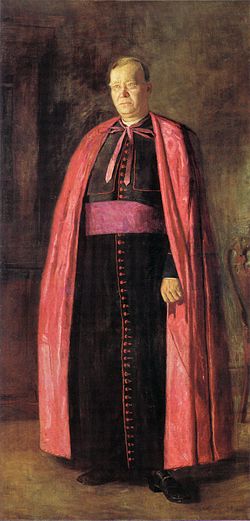
Current ecclesiastical dress