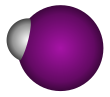
Hydroiodic acid is a topic that has captured the attention of countless people over time. Since its emergence, it has been approached from different perspectives and has aroused great interest in various fields of study. Its relevance has remained over the years, becoming a topic of constant debate and analysis. In this article, we will explore in detail all the aspects of Hydroiodic acid, from its origin to its impact on today’s society. We will discover how it has evolved over time and how it has influenced different generations. In addition, we will analyze its relevance in today’s world and its future projection. Join us on this journey of discovery and immersion in the fascinating world of Hydroiodic acid.
Aqueous solution of hydrogen iodide
|
|||
|
|||
| Names | |||
|---|---|---|---|
Other names
|
|||
| Identifiers | |||
| CAS Number |
|
||
| 3D model (JSmol) |
|
||
| ChEBI |
|
||
| ChemSpider |
|
||
| EC Number |
|
||
| PubChem CID |
|
||
| RTECS number |
|
||
| UNII |
|
||
InChI
|
|||
SMILES
|
|||
| Properties | |||
| Chemical formula | HI(aq) | ||
| Molar mass | 127.912 g·mol−1 (HI) | ||
| Appearance | colorless liquid | ||
| Odor | acrid | ||
| Density | 1.70 g/mL, azeotrope (57% HI by weight) |
||
| Boiling point | 127 °C (261 °F; 400 K) 1.03 bar, azeotrope | ||
| Solubility in water | Aqueous solution | ||
| Acidity (pKa) | −9.3 (HI)[1] | ||
| Hazards | |||
| GHS labelling: | |||
| Pictograms | 
|
||
| Signal word | Danger | ||
| Hazard statements | H314 | ||
| Precautionary statements | P260, P264, P280, P301+P330+P331, P303+P361+P353, P304+P340, P305+P351+P338, P310, P321, P363, P405, P501 | ||
| NFPA 704 (fire diamond) |
 |
||
| Flash point | Non-flammable | ||
| Related compounds | |||
| Other anions | |||
| Related compounds | Hydrogen iodide | ||
| Except where otherwise noted, data are given for materials in their standard state (at 25 °C , 100 kPa). | |||


Chemical compound
Hydroiodic acid (or hydriodic acid) is a colorless liquid. It is an aqueous solution of hydrogen iodide with the chemical formula HI(aq). It is a strong acid, in which hydrogen iodide is ionized completely in an aqueous solution. Concentrated aqueous solutions of hydrogen iodide are usually 48% to 57% HI by mass.[2]

Preparation
Main article: Hydrogen iodide § Synthesis
Reactions
Hydroiodic acid reacts with oxygen in air to give iodine:
4 HI(aq) + O2 → 2 H2O + 2 I2
Like hydrogen halides, hydroiodic acid adds to alkenes to give alkyl iodides. It can also be used as a reducing agent, for example in the reduction of aromatic nitro compounds to anilines.[3]
Cativa process
The Cativa process is a major end use of hydroiodic acid, which serves as a co-catalyst for the production of acetic acid by the carbonylation of methanol.[4][5]

Illicit uses
Hydroiodic acid is listed as a U.S. Federal DEA List I Chemical, owing to its use as a reducing agent related to the production of methamphetamine from ephedrine or pseudoephedrine (recovered from nasal decongestant pills).[6]
References
- ^ Perrin, D. D., ed. (1982) . Ionisation Constants of Inorganic Acids and Bases in Aqueous Solution. IUPAC Chemical Data (2nd ed.). Oxford: Pergamon (published 1984). Entry 32. ISBN 0-08-029214-3. LCCN 82-16524.
- ^ Lyday, Phyllis A. (2005). «Iodine and Iodine Compounds». Ullmann’s Encyclopedia of Industrial Chemistry. Weinheim: Wiley-VCH. pp. 382–390. doi:10.1002/14356007.a14_381. ISBN 978-3527306732.
- ^ Kumar, J. S. Dileep; Ho, ManKit M.; Toyokuni, Tatsushi (2001). «Simple and chemoselective reduction of aromatic nitro compounds to aromatic amines: reduction with hydriodic acid revisited». Tetrahedron Letters. 42 (33): 5601–5603. doi:10.1016/s0040-4039(01)01083-8.
- ^ Jones, J. H. (2000). «The Cativa Process for the Manufacture of Acetic Acid» (PDF). Platinum Metals Rev. 44 (3): 94–105.
- ^ Sunley, G. J.; Watson, D. J. (2000). «High productivity methanol carbonylation catalysis using iridium — The Cativa process for the manufacture of acetic acid». Catalysis Today. 58 (4): 293–307. doi:10.1016/S0920-5861(00)00263-7.
- ^ Skinner, Harry F. (1990). «Methamphetamine synthesis via hydriodic acid/Red phosphorus reduction of ephedrine». Forensic Science International. 48 (2): 123–134. doi:10.1016/0379-0738(90)90104-7.
External links
- International Chemical Safety Card 1326
- European Chemicals Bureau
- Viscosities of Aqueous Hydrochloric Acid Solutions, and Densities and Viscosities of Aqueous Hydroiodic Acid Solutions
Authority control databases: National  |
|
|---|