Nowadays, Enteroendocrine cell is a topic of growing interest in society. The importance of Enteroendocrine cell has been reflected in different areas, from politics to popular culture. Opinions and perspectives on Enteroendocrine cell are varied and often controversial, which has generated constant debate around this topic. In this article, we will thoroughly explore the relevance of Enteroendocrine cell today, analyzing its implications and possible consequences. From its impact on the economy to its influence on personal relationships, Enteroendocrine cell is a topic that leaves no one indifferent.
Cell that produces gastrointestinal hormones
| Enteroendocrine cell | |
|---|---|
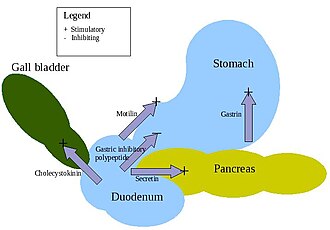
| Actions of the major digestive hormones secreted by enteroendocrine cells | |
| Details | |
| System | Endocrine system |
| Location | Gastrointestinal tract |
| Identifiers | |
| Latin | endocrinocyti gastroenteropancreatici |
| MeSH | D019858 |
| TH | H3.04.02.0.00024, H3.08.01.0.00003 |
| FMA | 62930 |
| Anatomical terms of microanatomy[edit on Wikidata] | |
Enteroendocrine cells are specialized cells of the gastrointestinal tract and pancreas with endocrine function. They produce gastrointestinal hormones or peptides in response to various stimuli and release them into the bloodstream for systemic effect, diffuse them as local messengers, or transmit them to the enteric nervous system to activate nervous responses.[1][2] Enteroendocrine cells of the intestine are the most numerous endocrine cells of the body.[3][4][5] They constitute an enteric endocrine system as a subset of the endocrine system just as the enteric nervous system is a subset of the nervous system.[6] In a sense they are known to act as chemoreceptors, initiating digestive actions and detecting harmful substances and initiating protective responses.[7][8] Enteroendocrine cells are located in the stomach, in the intestine and in the pancreas. Microbiota play key roles in the intestinal immune and metabolic responses in these enteroendocrine cells via their fermentation product (short chain fatty acid), acetate.[9]
Intestinal enteroendocrine cells
Intestinal enteroendocrine cells are not clustered together but spread as single cells throughout the intestinal tract.[7]
Hormones secreted include somatostatin, motilin, cholecystokinin, neurotensin, vasoactive intestinal peptide, and enteroglucagon.[10] The enteroendocrine cells sense the metabolites from intestinal commensal microbiota and, in turn, coordinate antibacterial, mechanical, and metabolic branches of the host intestinal innate immune response to the commensal microbiota.[11]
K cell
K cells secrete gastric inhibitory peptide, an incretin, which also promotes triglyceride storage.[12] K cells are mostly found in the duodenum.[13]
L cell
L cells secrete glucagon-like peptide-1, an incretin, peptide YY3-36, oxyntomodulin and glucagon-like peptide-2. L cells are primarily found in the ileum and large intestine (colon), but some are also found in the duodenum and jejunum.[14]
I cell
I cells secrete cholecystokinin (CCK), and have the highest mucosal density in the duodenum with a decreasing amount throughout the small intestine.[15] They modulate bile secretion, exocrine pancreas secretion, and satiety.[16]
G cell
Main article: G cell
Stomach enteroendocrine cells, which release gastrin, and stimulate gastric acid secretion.[17]
Enterochromaffin cell
Enterochromaffin cells are enteroendocrine and neuroendocrine cells with a close similarity to adrenomedullary chromaffin cells secreting serotonin.[18]
Enterochromaffin-like cell
Enterochromaffin-like cells or ECL cells are a type of neuroendocrine cell secreting histamine.
N cell
Located in a increasing manner throughout the small intestine, with the highest levels found in the in ileum,[19] N cells release neurotensin, and control smooth muscle contraction.[20]
S cell