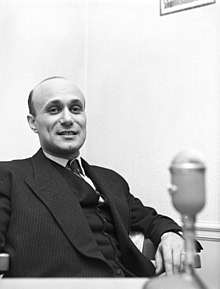
In today’s world, Bernard Pullman is a topic of great importance that continues to generate interest and debate. Bernard Pullman has long been a meeting point for a wide variety of opinions, and its relevance continues to rise today. Whether it is about historical, cultural, social or political aspects, Bernard Pullman continues to be a topic of constant relevance and continues to arouse the curiosity and interest of a wide spectrum of audiences. In this article, we will delve into the various aspects of Bernard Pullman, exploring its importance and implications in different contexts.
|
Bernard Pullman
|
|
|---|---|
 |
|
| Born | (1919-03-19)19 March 1919
Włocławek, Poland
|
| Died | 9 June 1996(1996-06-09) (aged 77) |
| Citizenship | French |
| Education | Sorbonne |
| Spouse | Alberte Pullman |
| Scientific career | |
| Fields | Quantum biochemistry |
| Institutions | CNRS, Sorbonne |
| Thesis | (1948) |
Bernard Pullman (19 March 1919, Włocławek Poland – 9 June 1996) was a French theoretical quantum chemist and quantum biochemist.
Pullman studied at the Sorbonne, then spent the Second World War as a French Army officer in Africa and the Middle East. Returning to Paris in 1946, he completed his licence ès sciences in 1946 and the Docteur-es-Science in 1948. From 1946 to 1954, he worked at the Centre National de la Recherche Scientifique (CNRS). In 1954 he was appointed Professor at the Sorbonne. In 1959, he became Director of the Department of Quantum Biochemistry at the Institut de biologie physico-chimique. In 1963, he was promoted to Director of the Institute. He was a founding member of the International Academy of Quantum Molecular Science.
Over the course of his career, Pullman published about 400 scientific papers and 5 books, three with his wife Alberte Pullman, his lifelong collaborator. In joint work published in the 1950s and 1960s, they founded the new field of quantum biochemistry. They also pioneered the application of quantum chemistry to predicting the carcinogenic properties of aromatic hydrocarbons.
After his 1989 retirement, he wrote The Atom in the History of Human Thought (Paris: Fayard, 1995), a work approachable by general readers.
References
- International Journal of Quantum Chemistry 75(3), 1999, Special Issue: In Memory of Bernard Pullman.
Books by Pullman
- 1963 (with Alberte Pullman). Quantum Biochemistry. New York: John Wiley Interscience. ISBN 978-0-470-70231-4 ; ISBN 0-470-70231-1.
- 1965 (with M. Weissbluth). Molecular Biophysics. New York: Academic Press, New York.
- 1998. The Atom in the History of Human Thought, trans. by Axel Reisinger. Oxford Univ. Press.
External links
- His International Academy of Quantum Molecular Science page
- An interview with Mme Prof. Dr. Alberte Pullman
| International | |
|---|---|
| National | |
| Academics | |
| Other | |

   |
This article about a Polish scientist is a stub. You can help Wikipedia by expanding it. |
.jpg) |
This biographical article about a chemist is a stub. You can help Wikipedia by expanding it. |