In today’s world, Al gran sole carico d’amore has become a topic of great relevance and interest to a large number of people. Whether due to its impact on society, its historical relevance or its influence on various aspects of daily life, Al gran sole carico d’amore has captured the attention of a wide audience. From its origins to its current evolution, Al gran sole carico d’amore continues to generate debates, reflections and deep analysis. In this article, we will explore different aspects related to Al gran sole carico d’amore, with the aim of delving into its importance and better understanding its impact on the modern world.
| Al gran sole carico d’amore | |
|---|---|
| Opera by Luigi Nono | |
.jpg) |
|
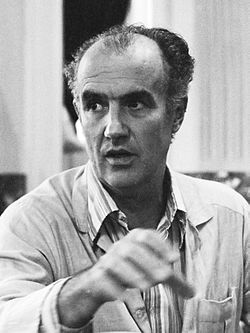
| Other title | The composer in 1979 |
| Librettist | |
| Language | Italian, French, German, Spanish |
| Based on | Plays by Bertolt Brecht, among others |
| Premiere |
4 April 1975 (1975-04-04)
|
Al gran sole carico d’amore (In the Bright Sunshine Heavy with Love) is an opera (designated as an ‘azione scenica’) with music by Luigi Nono, based mainly on plays by Bertolt Brecht, but also incorporating texts of Fidel Castro, Che Guevara, Karl Marx, and Vladimir Lenin. Nono himself and Yuri Lyubimov wrote the libretto. It premiered at the Teatro alla Scala on 4 April 1975, conducted by Claudio Abbado. Lyubimov directed the original production. The UK premiere was at the 32nd Edinburgh Festival in 1978.[1] In addition to vocal soloists, chorus and orchestra, the work incorporates taped sounds. This work is a product of Nono’s strong political activism through the mid-1970s.[2]
Roles
- Tania (soprano)
- Thiers (tenor)
- Favre (bass)
- Louise Michel (4 sopranos)
- L’ufficiale, the official (tenor)
- Il soldato, the soldier (tenor)
- Bismarck (bass)
- La madre, the mother (alto)
- Deola (4 sopranos)
- Pavel (baritone)
- Il direttore di una fabbrica russa del 1905, the manager of a Russian factory in 1905 (tenor)
- Il delatore, the police informer (tenor)
- Haydée (soprano)
- Una madre e donne vietnamite, a mother and Vietnamese women (soprano)
- Gramsci (baritone)
- Dimitrov (2 basses)
- Castro (bass)
- Male and female communards, guerillas, comrades, the people of Paris, modern workers, mothers, Sicilian immigrants, Cuban women, prisoners
Synopsis
The story is without conventional linear narrative, and comments in its two parts on the 1871 Paris Commune and the 1905 Russian Revolution. The principal characters are women from those periods, who perish in an attempt to stop the violence of their times.
Recordings
- Teldec New Line (2-CD set) 8573-81059-2: Claudia Barainsky, Maraile Lichdi, Melinda Liebermann, Stella Kleindienst, Lani Poulson, Roderic Keating, Markus Marquardt, Peter Kajlinger, Urs Winter, Helmut Holzapfel, Mark Munkittrick, Carsten Wittmoser; Chorus and Orchestra of the Staatsoper Stuttgart; Lothar Zagrosek, conductor. Recorded June–July 1999 in the Staatstheater Stuttgart.
References
- ^ McAllister, Rita, «Festivals: Edinburgh» (November 1978). The Musical Times, 119 (1629): pp. 980–983.
- ^ Gorodecki, Michael, «Strands in 20th-Century Italian Music: 1. Luigi Nono: A History of Belief» (January 1992). The Musical Times, 133 (1787): pp. 10–14, 16–17.
Further reading
- Osmond-Smith, David (2001). «Al gran sole carico d’amore». In Sadie, Stanley; Tyrrell, John (eds.). The New Grove Dictionary of Music and Musicians (2nd ed.). London: Macmillan Publishers. ISBN 978-1-56159-239-5.
- E. G. «Al gran sole carico d’amore di Luigi Nono«, in Piero Gelli (editor) Dizionario dell’opera, Baldini Castoldi Dalai, 2008. ISBN 88-6073-184-4 (archive from 12 February 2012).
| Opera | |
|---|---|
| Other compositions | |
| Family |
|
| Related articles | |

| International | |
|---|---|
| National | |
| Other | |