Today, in the digital age, 1796 in architecture has become a topic of great relevance in today’s society. From its impact on the economy to its influence on people’s daily lives, 1796 in architecture has been the subject of debate and analysis in different areas. With the advancement of technology and globalization, 1796 in architecture has become a key factor in human relations, industries and politics. In this article, we will explore the various facets of 1796 in architecture and its impact on modern life, as well as possible implications for the future.
|
|||
|---|---|---|---|
| Buildings and structures |
The year 1796 in architecture involved some significant events.
Events
- October 8 – The Sans Souci Theatre in Westminster, London, opens to the public, built by dramatist, musician and painter Charles Dibdin.

Buildings and structures
Buildings
- Somerset House in London, designed by William Chambers is completed.
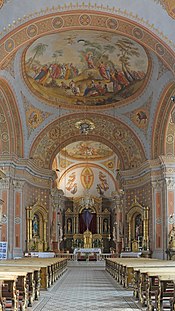
- The parish church of Urtijëi in the Italian Tyrol, designed by Joseph Abenthung, is completed.
- Hwaseong Fortress in Suwon, Korea, designed by Jeong Yak-yong, is completed.
- Work begins on Blaise Castle, commissioned by John Scandrett Harford from William Paty.
- Ffynone House near Boncath in Wales, designed by John Nash, is largely completed.
- The Mosque of Amr ibn al-As in Fustat, Egypt, is rebuilt by Mamluk leader Mourad Bey.
Births
- date unknown – Mortimer Lewis, Colonial Architect of New South Wales (died 1879)
Deaths
- January 11 – Jacob Otten Husly, Dutch neoclassical architect (born 1738)
- March 1 – Carl Fredrik Adelcrantz, Swedish architect and civil servant (born 1716)
- March 10 – William Chambers, English architect and Surveyor-General and Comptroller of the King’s Works (born 1723)

Wikimedia Commons has media related to 1796 in architecture.
 |
This article about history of architecture is a stub. You can help Wikipedia by expanding it. |